
Beyond the Spotlight: A Life Shaped by Music
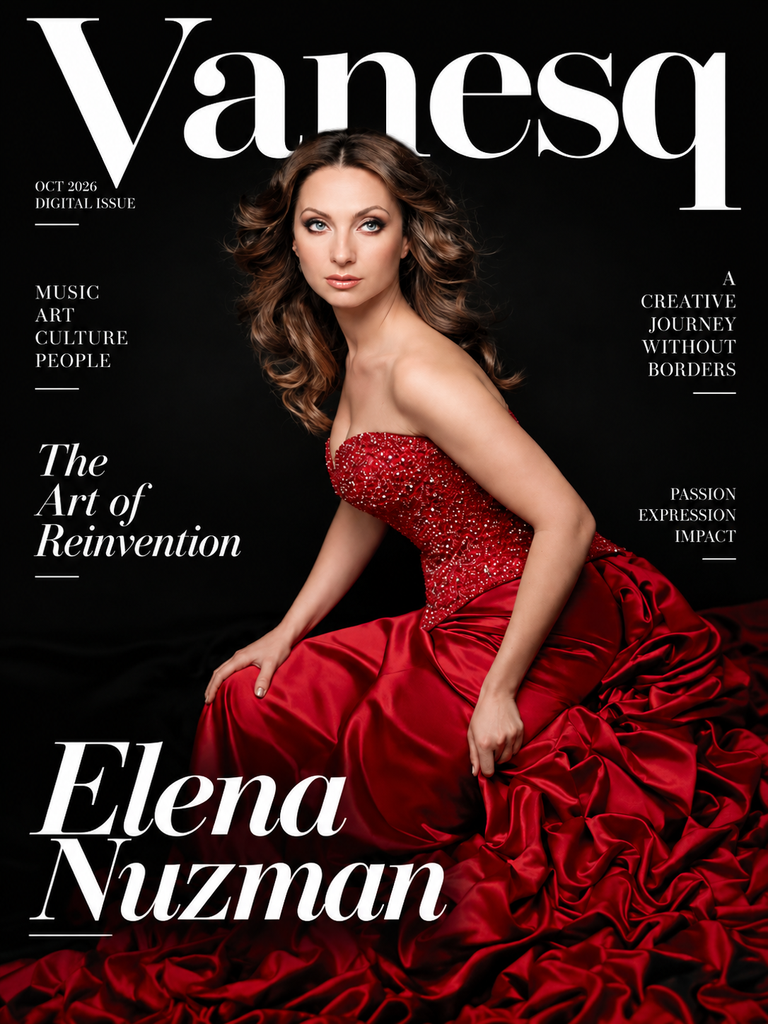
Some artists captivate audiences through their presence, while others leave a lasting impression through the depth of their talent. Elena Nuzman brings these qualities together through a musical journey defined by classical discipline, contemporary expression, and a willingness to explore beyond familiar boundaries. As a concert pianist, vocalist, and composer, she has developed an artistic identity that reflects both technical excellence and personal creativity.
For Nuzman, music has never been limited to a single instrument or genre. Her work moves between classical piano, pop, and rock, creating a distinctive space where tradition meets modern expression. This versatility is not simply a professional advantage. It is a reflection of how she understands music itself, as a universal language capable of communicating emotions that words often struggle to express.
Her story is one of dedication, discovery, and evolution. From her early childhood in Moldova to her musical education in Europe and her performances before international audiences, Nuzman has continually explored new ways to express herself while remaining connected to the foundations that first inspired her.
A Childhood Surrounded by Music
Born in Moldova into a family of professional musicians, Nuzman grew up in an environment where music was an essential part of everyday life. Instruments, melodies, and musical conversations surrounded her from an early age, creating an atmosphere in which creativity and discipline developed together.
Her natural musical instincts became apparent when she was still a toddler. At just two years old, she was already reproducing melodies on the piano by ear, demonstrating an unusual sensitivity to sound and musical patterns. What began as an instinctive response to the music around her gradually developed into a serious commitment to the art.
At seven, she entered a prestigious music academy for gifted students, beginning a demanding period of classical training. The experience introduced her to the discipline required to master an instrument and the patience necessary to develop a distinctive artistic voice.
Classical music became the foundation of her professional identity. Years of practice strengthened her technique, expanded her understanding of musical structure, and taught her to approach every performance with concentration and precision.
Yet even during these formative years, her relationship with music extended beyond the pursuit of technical perfection. The piano offered her a way to communicate, explore emotions, and discover possibilities that would eventually lead her toward other forms of performance.
An International Education and Expanding Horizons
Nuzman’s musical journey gradually extended beyond the country where it began. Her experiences across Russia, France, the United States, Israel, and Canada introduced her to different cultures, audiences, and artistic environments.
Each new setting offered opportunities to broaden her perspective and understand how music could connect people across geographical and cultural boundaries. Although classical music provided a shared foundation, the ways in which people experienced and responded to it could differ considerably.
Her education continued at the renowned Robert Schumann University of Music in Düsseldorf, Germany, where she completed a master’s degree in concert piano.
This advanced training strengthened her command of the instrument and deepened her understanding of the traditions that shaped classical performance. It also prepared her for a career that would require both the precision of a concert pianist and the adaptability of an artist willing to explore unfamiliar creative territory.
For Nuzman, education was not simply about reaching a particular qualification. It was part of a lifelong process of development, one that continues whenever she encounters a new musical idea or challenges herself to approach a familiar composition differently.
Discovering the Power of Her Voice

Although the piano established her musical reputation, another dimension of Nuzman’s artistry emerged through singing.
Her transition into vocal performance was not originally the central ambition of her career. An opportunity to participate in a vocal competition, however, became an important turning point. She won first prize in the Rock-Pop category, discovering that her expressive abilities could extend far beyond the concert piano.
The achievement opened a new creative direction. With a reported four-octave vocal range, Nuzman began developing a performance style that combined musical precision with the intensity and freedom of contemporary singing.
Her debut album, I Believe In You, introduced audiences to this combination of classical sensibility and modern energy. Blending emotional ballads with rock interpretations, the album demonstrated her ability to approach popular music with a perspective shaped by years of classical study.
The record entered the German Newcomer Charts and remained in the Top 10 for several weeks, helping introduce her work to a wider audience.
Among the notable performances associated with this period was her interpretation of Whitesnake’s classic song “Here I Go Again.” The performance reached large audiences, including those attending New Year’s Eve celebrations at Berlin’s Brandenburg Gate.
For Nuzman, the experience reinforced an important idea: different musical styles can offer different ways to express the same human emotions. The power of a performance lies not only in its technical execution but also in its ability to create a connection with listeners.
Where Classical Tradition Meets Contemporary Creativity
Nuzman’s second album, Liebestraum, represented another significant stage in her artistic development. Inspired by Romantic-era composers, the project explored how classical piano traditions could interact with contemporary pop music.
Rather than treating classical and modern music as separate categories, she approached them as complementary forms of expression. The result was a musical concept that drew upon the emotional depth of classical compositions while embracing the accessibility of contemporary songwriting.
The project also reflected her growing confidence as a composer. By writing many of the songs herself, Nuzman expanded her role from interpreter to creator, developing music that reflected her own artistic instincts.
The title track attracted considerable attention, surpassing four million views on YouTube and earning the IMPALA Silver Award.
These achievements illustrated the potential of her crossover approach. Classical music could provide structure, harmony, and emotional complexity, while contemporary arrangements could introduce those qualities to audiences with different musical preferences.
For Nuzman, experimentation does not mean abandoning tradition. Instead, it offers an opportunity to preserve what makes classical music enduring while discovering new ways to share its emotional richness.
Returning to the Piano With a New Perspective
In 2025, Nuzman released My Piano And I, an album that brought her relationship with the piano back into focus.
The record combines celebrated songs, new compositions, and English versions of selected works, reflecting an artist who continues to revisit her musical foundations while exploring fresh creative possibilities.
The title carries a personal significance. The piano was the instrument through which Nuzman first discovered her abilities, the discipline through which she developed her craft, and the foundation upon which she built an international career.
Yet her relationship with the instrument has evolved over time. The young musician who once reproduced melodies by ear has become a performer whose experiences across genres, countries, and stages inform the way she approaches music.
The album represents this evolution, bringing together the technical knowledge of a classically trained pianist and the expressive freedom of a vocalist and composer.
A Personal Definition of Success

In a career that spans classical performance, contemporary music, composition, and international appearances, Nuzman’s journey offers a broader perspective on artistic achievement.
Success is often measured through awards, chart positions, audience numbers, and professional recognition. These milestones can be important, but they represent only part of an artist’s story.
The deeper measure lies in the ability to continue developing, remain curious, and create work that feels meaningful. Nuzman’s willingness to move between musical traditions demonstrates an interest in growth rather than a desire to remain within the boundaries established by early success.
Her journey also highlights the importance of discipline. The freedom to experiment is often supported by years of preparation, technical practice, and careful study. Behind the apparent ease of a performance lies a foundation built through patience and commitment.
This balance between structure and exploration has become one of the defining characteristics of her musical identity.
The Continuing Evolution of Elena Nuzman
Elena Nuzman’s artistic story is ultimately about the possibilities that emerge when talent is supported by dedication and an openness to change.
From a musical childhood in Moldova to advanced studies in Germany, from classical concert performance to rock and pop, and from interpreting compositions to creating her own, she has continually expanded her understanding of what a musical career can encompass.
Her identity as a pianist, singer, and composer reflects a belief that creativity does not need to follow a single path. Different genres can coexist, traditions can inspire innovation, and personal experience can become the starting point for new artistic discoveries.
As she continues to develop her work, the relationship between classical mastery and contemporary expression remains central to her approach. The piano continues to connect her present with her beginnings, while her voice opens the door to new forms of communication.
Elena Nuzman represents an artistic journey shaped not by boundaries but by possibilities. Her story reminds us that the most compelling creative identities are often those that continue to evolve, embracing new challenges without losing sight of the foundations that made the journey possible in the first place.